
01At a Glance
- Product tier
- L1 · Foundation & Connectivity
- Deployment
- SaaS + Private (private-first)
- Access scale
- 40+ models / 40+ channel adapters
- API standard
- OpenAI-compatible
/v1 - Billing
- Token / multiplier / session
- Payments
- Stripe + ePay
02Positioning
The “access foundation” of enterprise AI infrastructure — collapsing the fragmentation of “too many models, messy interfaces, chaotic bills, and security gaps” into one interface, one billing, one governance.
An enterprise AI API gateway for unified model access and cost governance: 40+ models in one place — one scheduling, one settlement.
Not locked to any single model vendor, and not a mere reverse proxy — it embeds metering & billing, auth & security, channel operations, and usage analytics.
The connectivity foundation (L1) of the MAXLAKER stack, supplying unified model & compute capacity for Knowledge, Studio, and industry agents.
03Overview
As the LLM ecosystem grows richer, enterprises face a fragmentation problem: “too many models, messy interfaces, chaotic bills, and security gaps.” As the access foundation of enterprise AI infrastructure, MAXLAKER AIHub consolidates 40+ third-party model services — OpenAI, Claude, Gemini, DeepSeek, Qwen, ERNIE, Hunyuan, Kimi, MiniMax, Midjourney, and video generation models — into one OpenAI-compatible unified API. Integrate once, and schedule any model on demand.
AIHub ships a custom billing engine (token metering / multiplier billing / session billing) with top-ups, subscriptions, and redemption codes, covering Stripe and ePay payments. It also embeds API-key authentication, OAuth, WebAuthn, TOTP two-step verification, plus SSRF/CSRF protection, circuit breaking, and rate limiting to support enterprise security and operations governance; production readiness still depends on environment-specific configuration and assessment.
The product is private-deployment-first: a Go single binary with an embedded frontend, one-command Docker Compose deployment (MySQL 8 + Redis required), systemd bare-metal deployment, and offline image import. Managed instances and a SaaS token service are also available on demand.
04Core Value
Cost & efficiency
One integration covers every model — no per-vendor onboarding or settlement, sharply lower integration and maintenance cost.
Cost transparency
Token metering, multiplier and tiered billing, quotas, and reconciliation keep model spending visible, manageable, and controllable.
Security & compliance
Multi-layer authentication (API key / OAuth / TOTP), SSRF/CSRF protection, and circuit breaking & rate limits; one-command Docker private deployment lets enterprises plan gateway operations around their own environment.
Business enablement
Tiered channel distribution, usage dashboards, and performance metrics support token procurement, department accounting, and downstream customer operations.
05Key Capabilities
| Capability | Description |
|---|---|
| Unified model access | 40+ model services through 40+ upstream channel adapters, one OpenAI-compatible /v1/chat/completions interface, smart routing & health checks |
| Unified metering & billing | Token metering (input/output/cache), multiplier & tiered billing, pre-charge; top-ups (Stripe/ePay), subscriptions, redemption codes, wallet balance |
| Authentication & security | API key management, OAuth, WebAuthn, TOTP two-step verification; SSRF/CSRF protection, circuit breaker, rate limits, security headers |
| Channel management | Add/remove upstream channels, grouping, multiplier settings, connectivity tests, and health monitoring |
| Usage & quotas | Usage logs, task logs, usage dashboards, and performance metrics (TTFT / latency / TPS / success rate), with usage and cost split by organization / department / group |
| Admin console | Site branding, authentication, billing & payments, model routing, security limits, operations settings; organization & department hierarchy management; console in 6 languages |
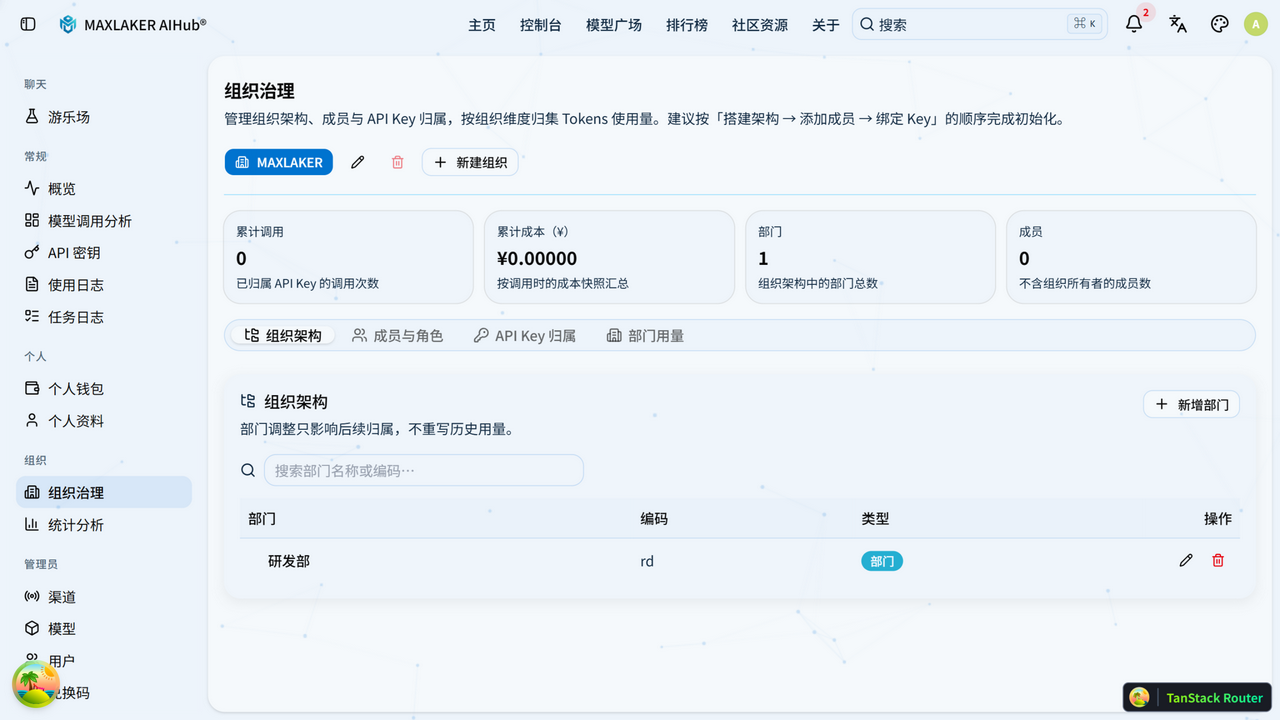
| Organization & department governance | Multi-level organization → department hierarchy with five roles (owner / admin / unit admin / auditor / member); API keys bound to organization units and suspendable; token usage and cost metered per organization / department |
| Debugging & collaboration | Online playground, multi-model chat, session sharing (chat2link), public pricing page, model comparison & leaderboard |
06Unique Advantages
- Private-first: Go single binary with embedded frontend, one-command Docker Compose, systemd bare-metal, and offline image import — enterprises can plan gateway deployment and operations around their own environment;
- Standard interface: OpenAI-compatible
/v1API — existing AI clients and frameworks can usually be configured without changing their call format; - Custom billing engine: Token / multiplier / session billing plus top-ups (Stripe / ePay), subscriptions, and redemption codes — for internal accounting and external operations alike;
- Security hardening: SSRF / CSRF protection, circuit breaker, rate limits, security headers, and multi-factor login protection provide a foundation for enterprise security governance;
- Channel ecosystem: 40+ upstream adapters with smart routing and health checks — failed channels are avoided automatically, and traffic can shift to cost-efficient models;
- Enterprise governance: a multi-level organization → department hierarchy, five roles, API keys bound to organization units with suspension, and usage/cost metered by organization, department, and group — meeting multi-department accounting and audit needs;
- Observable & controllable: TTFT / latency / TPS / success-rate metrics with usage and task logs for end-to-end visibility.
07Model Ecosystem (Partial)
08Who It's For
Supply models to internal applications through one interface, covering every model need with less vendor management.
Integrate multiple models through an OpenAI-compatible interface — skip per-vendor adaptation and settlement, focus on product.
Unified metering, quotas, and reconciliation bring model spending under budget — no more runaway bills.
Token procurement plus channel distribution to subsidiaries, departments, or downstream customers with metering and settlement.
Finance, government, and manufacturing can evaluate private or offline deployment according to their own environments and model-channel requirements.
09Use Cases
- Unified enterprise model access: dev teams reach every model through one interface — no per-vendor onboarding or settlement;
- App development & API integration: stable model supply for internal apps, AI agents, and industry solutions;
- Token procurement & channel distribution: centralize model capacity, then distribute and settle by department, subsidiary, or downstream customer;
- Multi-vendor failover & cost optimization: health checks and smart routing avoid failed channels automatically, and multiplier settings steer traffic toward cost-efficient models;
- Model evaluation & selection: built-in playground, model comparison, and leaderboard — run the same prompt across models, pick the best, then lock it into production.
10Deployment
| Mode | Description |
|---|---|
| Docker Compose one-command | Gateway + MySQL 8 + Redis, single command startup — recommended |
| systemd bare-metal | For enterprises with existing server ops; deployment scripts and boot autostart included |
| Offline deployment | docker save / load image import with intranet npm frontend build — for air-gapped environments |
| Managed instance | Instant on — for quick validation and small-to-mid teams |
11Quick Start (4 Steps)
- Deploy: follow the Docker Compose guide, open the console, and initialize the admin account;
- Configure channels: register upstream model channels (API key, group, multiplier) and test connectivity;
- Create tokens: generate an API key for your app with limits and quotas;
- Call: point your client's Base URL at the gateway
/v1(OpenAI-compatible) with your API key — existing AI clients can be configured directly.
12FAQ
What is MAXLAKER AIHub?
It is the enterprise private AI Token Hub gateway: unified access to 40+ third-party model services with unified metering & billing, authentication, and channel management — one interface for all major models.
Which models are supported?
40+ domestic and international models, including OpenAI, Claude, Gemini, DeepSeek, Qwen, ERNIE, Hunyuan, Midjourney, and video generation models — with continuous expansion.
How is token usage billed?
Token metering (input/output/cache) with multiplier-based billing; top-ups (Stripe/ePay), subscriptions, and redemption codes supported, with enterprise-grade reconciliation, quotas, and tiered channel distribution.
What does private deployment require?
Docker Compose one-command deployment, systemd bare-metal deployment, or offline image import; a Go single binary with embedded frontend, requiring MySQL 8 + Redis. Deployment and operations can be evaluated around your enterprise environment.
How do I integrate quickly?
Create a token (API key) in the console after deployment; the interface is OpenAI-format compatible — just switch the endpoint. Existing AI clients can be configured directly.
Does it support organization/department-level management?
Yes. A built-in organization governance module provides a multi-level organization → department hierarchy, five roles (owner / admin / unit admin / auditor / member), API keys bindable to organizations or departments (with suspension), and token usage and cost metered by organization / department / group — meeting multi-department accounting and audit requirements.
What security capabilities are included?
API key authentication, OAuth/WebAuthn/TOTP login protection, server-side SSRF/CSRF protection, circuit breaker, and rate limits — providing a foundation for enterprise security governance; final controls should be assessed against your environment.